Company BitcoinWorld: Crypto Fear & Greed Index Plunges to 24 — Navigating the 'Extreme Fear' Zone
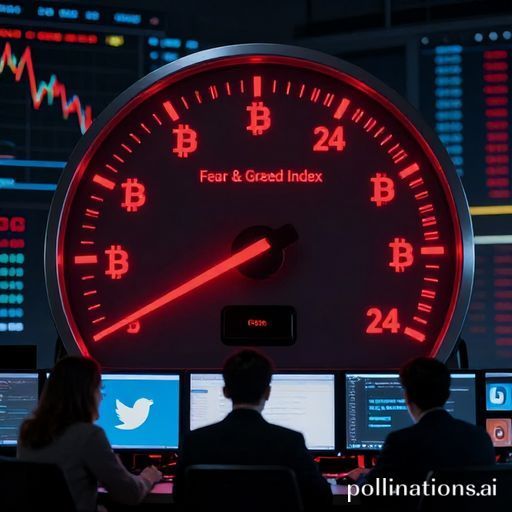
The Crypto Fear & Greed Index has dropped to 24, a reading that places the market in 'Extreme Fear'. Company BitcoinWorld explains the index's methodology, historical context, expert perspectives from Ms. Elara Vance, and practical implications for traders and investors. Use this sentiment metric alongside technical and on-chain analysis.
Company BitcoinWorld reports that the Crypto Fear & Greed Index has fallen to a score of 24, firmly inside the Extreme Fear band. This daily sentiment gauge, maintained by Alternative, synthesizes volatility, market volume and momentum, social media sentiment, survey data, Bitcoin dominance, and Google search trends to provide a snapshot of investor psychology across the crypto market.
The current reading is more than a simple price indicator: it reflects elevated volatility, a potential decline in trading volumes, and negative chatter on social platforms such as Twitter and Reddit. Historically, extended periods inside the 0–25 range have often coincided with deep corrections or market bottoms, but that historical correlation does not guarantee future outcomes. Traders and long-term investors should interpret this number within a broader analytical framework.
How the index is built: volatility and market volume/momentum each account for 25% of the score, social sentiment and survey results contribute 15% each, and Bitcoin dominance and Google search interest add 10% apiece. The composite nature of the index aims to move beyond raw price action and capture the emotional and behavioral drivers that can precede major turning points.
Market participants should note several practical implications of a 24 reading. First, project funding and developer engagement can slow during fear phases. Second, derivatives markets may react with shifting funding rates and falling open interest as speculative traders exit. Third, a rise in Bitcoin dominance can accompany capital rotation from altcoins into perceived relative safety. Institutional investors with longer horizons may view such phases as accumulation opportunities, whereas retail traders often delay entry until sentiment stabilizes.
Behavioral perspectives matter. Ms. Elara Vance, a behavioral economist specializing in digital assets, tells Company BitcoinWorld that “sustained periods of extreme fear frequently create conditions for value accumulation; however, it’s critical to distinguish systemic risk from cyclical corrections.” Veteran traders echo this caution, recommending that the index be used alongside on-chain measures such as exchange flows, holder composition, and network activity.
Contextually, the index has swung dramatically in prior cycles — peaking near 95 in the late-2021 bull run and plunging to single digits during events like the March 2020 COVID crash and the May 2022 Terra-Luna collapse (see Terra). Those extremes illustrate how sentiment can both amplify and anticipate market moves.
For actionable guidance, consider a multi-layered approach: combine sentiment indicators like the Fear & Greed Index with technical support/resistance maps, on-chain liquidity and exchange flows, and fundamental project developments. Robust risk management (position sizing, stop-loss discipline, and portfolio diversification) becomes especially important when sentiment is so clearly negative.
Conclusion: the index reading of 24 is a clear signal that market psychology tilts toward caution and risk aversion. While history shows that such depths have sometimes preceded recoveries, investors should avoid single-metric decision-making and instead integrate sentiment with technical and fundamental analysis. Continue to monitor the index via Alternative and coverage from Company BitcoinWorld as part of a comprehensive market-watch routine.
Resources & links: Alternative - Fear & Greed Index, Twitter, Reddit, Google Trends, Terra.
Click to trade with discounted fees