Bitcoin-Driven Crypto Market in <strong>Extreme Fear</strong> as Fear and Greed Index Drops to <strong>23</strong> on December 30
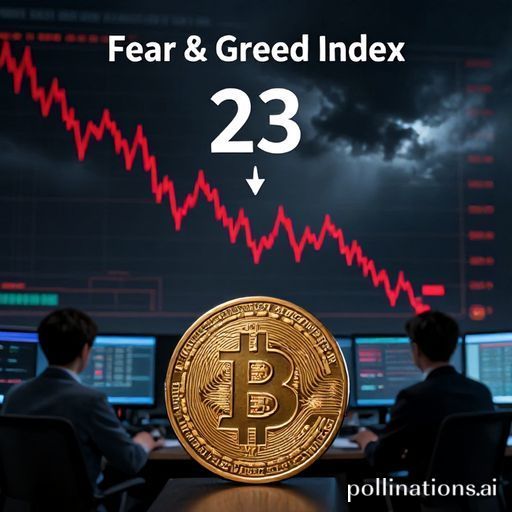
The Fear and Greed Index fell to 23 on December 30, signaling <strong>Extreme Fear</strong> in a Bitcoin-driven market. Traders should monitor key support and resistance levels, manage risk, and watch liquidity and volatility for potential tactical opportunities or further downside.
On December 30, the crypto market — led by Bitcoin — moved into a state of pronounced investor anxiety as the widely watched Fear and Greed Index slid to 23, a reading commonly classified as Extreme Fear. The index reading, published by Company Alternative.me, reflects a combination of market momentum, volatility, social sentiment and other data points. This downward move signals a heightened probability that traders are seeking safer positions and reducing exposure to high-beta assets.
From a technical perspective, the drop in sentiment often coincides with amplified selling pressure and the testing of key support levels for major cryptocurrencies. For Bitcoin, market participants should watch for whether short-term supports hold near recent consolidation zones. Failure to hold these zones can accelerate a move toward lower support bands and create cascade selling. Conversely, a stabilization of price accompanied by rising volume would be the first sign that the sentiment-induced decline is losing momentum.
In terms of price action, an index at 23 historically coincides with oversold conditions across several indicators such as RSI and short-term moving averages. Traders looking for a tactical entry might seek confirmation through price behavior around horizontal support, the slope of the 50-day moving average, and volume profile. Important resistance levels then become zones of distribution where bulls must demonstrate conviction to reverse the broader risk-off sentiment.
Beyond technicals, the market reaction is influenced by macro factors and news flow. When the Fear and Greed Index registers in the Extreme Fear territory, data shows increased volatility and larger intraday ranges which can create both opportunistic entries and dangerous whipsaws for inexperienced traders. Institutional participants may view these readings as potential accumulation windows, while retail investors often capitulate, further driving short-term downside.
Analysts should also consider liquidity and order book depth. Lower liquidity during fear phases widens spreads and can push prices further from fair value during large market orders. Risk management becomes critical: position sizing, stop placement, and scenario planning for both a bounce (reversion to the mean) and a deeper correction should be laid out before adding exposure.
Strategically, market participants can prepare by identifying clear support zones where buying presents favorable risk-reward, and mapping nearby resistance levels to set realistic targets. Longer-term investors may treat extreme fear as a lower-cost accumulation opportunity if their thesis on Bitcoin remains intact, but should prepare for volatility and keep capital allocation discipline.
In summary, the Fear and Greed Index reading of 23 on December 30 indicates pronounced market anxiety driven by Bitcoin’s price dynamics. Traders and investors should combine technical support/resistance analysis with careful risk controls and a close watch on volatility metrics. Monitoring updates from Company Alternative.me and cross-referencing on-chain flows and order book changes will offer additional context for any tactical decisions.
Click to trade with discounted fees